Discover how smart manufacturing is transforming modern production efficiency through automation, IoT connectivity, predictive maintenance, and real-time monitoring. Learn how manufacturers reduce downtime, improve productivity, optimise workflows, and make faster data-driven decisions while balancing digital transformation with workforce development. This article explores the technologies, strategies, and long-term benefits shaping the future of intelligent manufacturing across industries.
Smart manufacturing is changing modern production by helping manufacturers improve efficiency, reduce downtime, and make faster operational decisions using connected technologies. By combining automation, industrial IoT, predictive maintenance, and real-time analytics, manufacturers can streamline workflows, lower operational costs, and respond more quickly to changing market demands.
Manufacturers across industries are adopting smart manufacturing systems because they improve productivity without relying solely on manual processes. From automotive plants to food processing facilities, companies are using connected machines, digital monitoring platforms, and data-driven production strategies to stay competitive, improve quality control, and reduce waste.
What Is Smart Manufacturing?
Smart manufacturing is a technology-driven production approach that uses connected systems, automation, data analytics, and machine learning to optimise manufacturing operations in real time. It allows factories to monitor equipment performance, predict maintenance needs, automate repetitive tasks, and improve decision-making across the production floor.
Unlike traditional manufacturing systems that rely heavily on manual oversight, smart manufacturing creates a connected environment where machines, sensors, software, and operators communicate continuously.
Core Technologies Behind Smart Manufacturing
Several technologies work together to support modern smart factories:
| Technology | Primary Function | Operational Benefit |
|---|---|---|
| Industrial IoT (IIoT) | Connects machines and sensors | Real-time data visibility |
| Automation Systems | Handles repetitive production tasks | Faster production speed |
| Predictive Maintenance | Detects potential equipment failures | Reduced downtime |
| Artificial Intelligence | Analyses operational data | Smarter decision-making |
| Cloud Computing | Stores and processes manufacturing data | Easier scalability |
| Digital Twins | Creates virtual production models | Improved process testing |
| Robotics | Assists with precision tasks | Better consistency and safety |
These technologies help manufacturers move from reactive operations to proactive production management.
How Smart Manufacturing Improves Production Efficiency
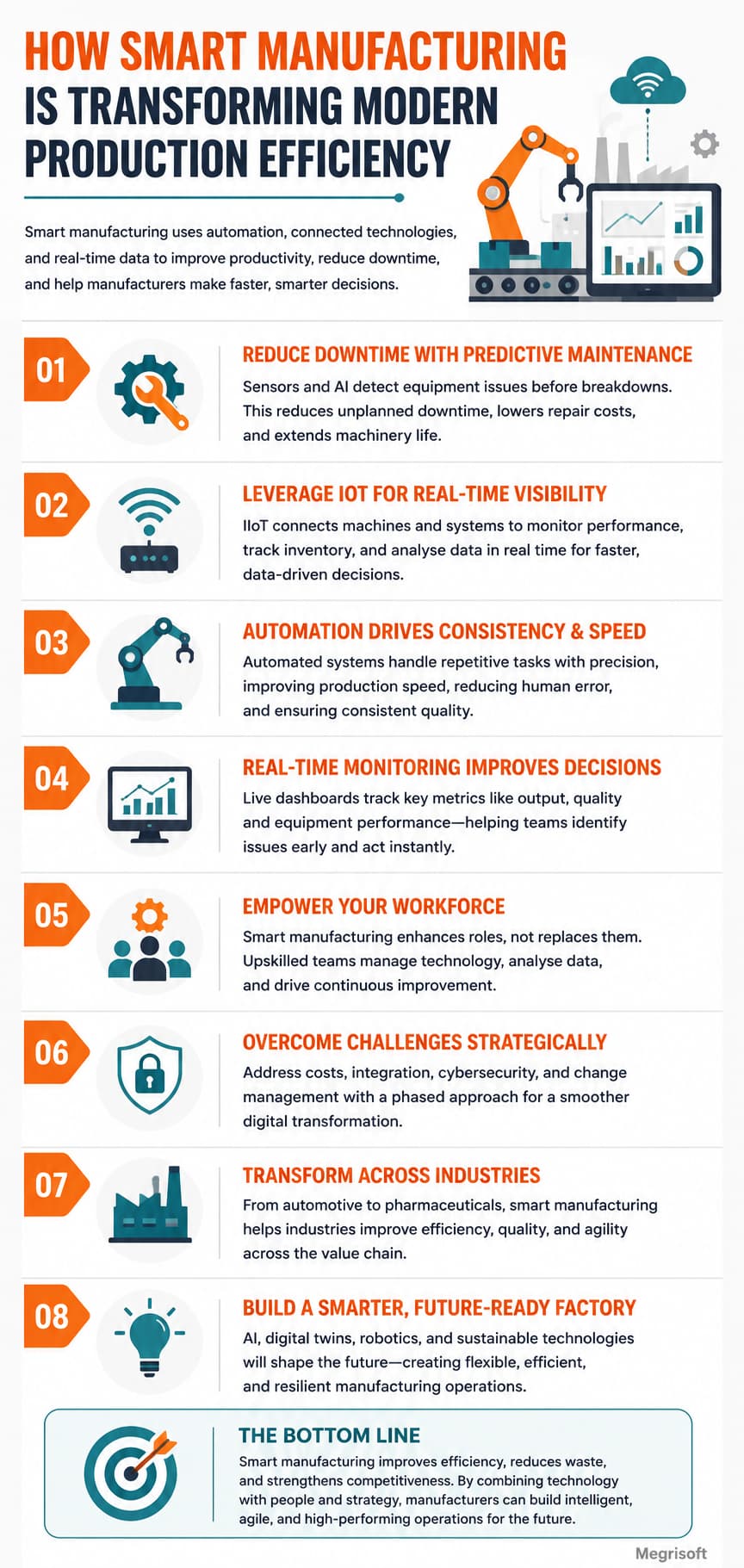
Smart manufacturing improves production efficiency by reducing delays, improving machine utilisation, and helping manufacturers make faster operational adjustments. Real-time monitoring allows production teams to identify inefficiencies immediately instead of waiting for problems to escalate.
Modern manufacturing facilities increasingly depend on connected systems because they improve visibility across every stage of production.
1. Reducing Equipment Downtime
Unexpected downtime remains one of the largest operational costs in manufacturing. Smart manufacturing systems use predictive maintenance tools and sensor-based monitoring to identify early signs of equipment failure before breakdowns occur.
For example, vibration sensors, temperature tracking, and machine learning software can detect abnormalities in motors, conveyors, or pumps. Maintenance teams can then schedule repairs before production stops unexpectedly.
Benefits of Predictive Maintenance
- Reduces unplanned shutdowns
- Extends equipment lifespan
- Improves maintenance scheduling
- Lowers emergency repair costs
- Increases production reliability
According to research from IBM, predictive maintenance strategies can significantly reduce maintenance costs and improve equipment uptime when compared to reactive maintenance models.
The Role of IoT in Smart Manufacturing
Industrial IoT technology allows manufacturers to collect and analyse data from connected equipment in real time. Sensors embedded in machines continuously monitor production conditions such as temperature, pressure, energy usage, and output quality.
This data helps production managers identify operational bottlenecks quickly and make informed adjustments before small issues affect overall productivity.
Examples of IoT Applications in Manufacturing
| IoT Application | Manufacturing Impact |
|---|---|
| Machine health monitoring | Prevents equipment failure |
| Inventory tracking | Reduces material shortages |
| Energy monitoring | Lowers utility costs |
| Production tracking | Improves workflow visibility |
| Environmental monitoring | Enhances workplace safety |
Real-time visibility is one of the biggest advantages of smart manufacturing because it helps businesses make immediate operational improvements instead of relying on outdated reporting methods.
Automation Is Reshaping Manufacturing Operations
Automation improves manufacturing efficiency by reducing repetitive manual work, improving consistency, and increasing production speed. Automated systems help manufacturers maintain stable output levels while reducing the risk of human error.
Many facilities now combine robotics with AI-driven software to improve precision and maintain production quality across high-volume operations.
Areas Where Automation Delivers the Biggest Impact
Assembly Line Operations
Automated assembly systems improve speed and consistency in repetitive manufacturing tasks.
Quality Inspection
AI-powered cameras and sensors can detect defects faster than traditional manual inspections.
Material Handling
Automated guided vehicles (AGVs) and robotic systems help move materials efficiently across production facilities.
Packaging and Distribution
Automation speeds up packaging workflows while reducing labour-intensive tasks.
According to McKinsey & Company, manufacturers adopting advanced automation and smart technologies often achieve measurable improvements in operational productivity and supply chain responsiveness.
Real-Time Monitoring Helps Manufacturers Make Faster Decisions
Real-time monitoring gives manufacturers immediate access to production data, allowing managers to respond quickly to operational issues. Instead of waiting for end-of-day reports, teams can track machine performance, production output, and quality metrics instantly.
This improves operational agility and reduces delays caused by slow decision-making.
Key Metrics Tracked in Smart Factories
- Production output rates
- Machine uptime
- Energy consumption
- Product defect rates
- Inventory levels
- Labour efficiency
- Equipment performance trends
Manufacturers that rely on real-time dashboards can identify performance issues earlier and improve coordination between maintenance, production, and logistics teams.
How Smart Manufacturing Supports Workforce Efficiency
Smart manufacturing does not replace workers entirely. Instead, it changes how employees interact with technology and production systems. Modern manufacturing facilities increasingly need skilled workers who can operate automated systems, interpret production data, and manage connected technologies.
Successful manufacturers invest heavily in workforce training alongside technology adoption.
Skills Becoming More Important in Smart Manufacturing
| Skill Area | Why It Matters |
|---|---|
| Data analysis | Helps interpret production insights |
| Robotics operation | Supports automated workflows |
| Equipment diagnostics | Improves maintenance response |
| Cybersecurity awareness | Protects connected systems |
| Digital system management | Enhances operational efficiency |
Companies that combine technology investment with employee development usually experience smoother digital transformation outcomes.
Challenges Manufacturers Face During Digital Transformation
Smart manufacturing offers major operational benefits, but implementation also comes with challenges. Manufacturers often need to balance technology adoption with operational continuity, budget limitations, and workforce readiness.
Common Smart Manufacturing Challenges
High Initial Investment
Connected systems, robotics, and industrial software platforms can require significant upfront spending.
Integration Issues
Older manufacturing equipment may not easily connect with newer smart technologies.
Cybersecurity Risks
Connected production systems increase exposure to cybersecurity threats if not properly secured.
Employee Resistance
Workforce concerns about automation can slow technology adoption if communication and training are not prioritised.
Data Management Complexity
Large volumes of operational data require strong analytics systems and clear management processes.
Manufacturers that approach digital transformation gradually often achieve better long-term results than businesses attempting rapid large-scale implementation without planning.
Industries Benefiting Most From Smart Manufacturing
Smart manufacturing technologies are being adopted across multiple industries because operational efficiency remains a universal priority.
Industries Leading Smart Manufacturing Adoption
- Automotive manufacturing
- Electronics production
- Food and beverage processing
- Pharmaceutical manufacturing
- Aerospace engineering
- Consumer goods manufacturing
- Heavy industrial production
Each industry uses smart manufacturing differently, but the core goal remains the same: improving efficiency, reducing waste, and increasing operational visibility.
The Future of Smart Manufacturing
Smart manufacturing will continue evolving as AI, machine learning, robotics, and industrial connectivity become more advanced. Manufacturers are increasingly focusing on flexible production systems that can adapt quickly to supply chain disruptions, shifting customer demands, and labour challenges.
Future smart factories will likely depend even more on autonomous systems, advanced analytics, and sustainable production strategies.
Emerging Trends in Smart Manufacturing
| Emerging Trend | Potential Impact |
|---|---|
| AI-driven production planning | Faster operational decisions |
| Digital twins | Better production simulation |
| Edge computing | Faster data processing |
| Sustainable manufacturing systems | Lower environmental impact |
| Collaborative robotics | Improved worker support |
According to Deloitte Insights, smart factory adoption continues accelerating because manufacturers increasingly view digital transformation as essential for long-term competitiveness.
Conclusion
Smart manufacturing is transforming modern production efficiency by combining automation, real-time monitoring, predictive maintenance, and connected technologies into a more intelligent operational system. Manufacturers adopting these technologies can improve productivity, reduce downtime, strengthen quality control, and make faster data-driven decisions across their facilities.
While implementation requires investment, workforce training, and careful planning, the long-term benefits often outweigh the challenges. As industrial technology continues evolving, smart manufacturing will remain a critical strategy for companies aiming to improve operational performance, increase resilience, and stay competitive in rapidly changing global markets.
Frequently Asked Questions
What is the main goal of smart manufacturing?
The main goal of smart manufacturing is to improve production efficiency through automation, real-time data analysis, and connected systems. Manufacturers use smart technologies to reduce downtime, improve product quality, increase operational visibility, and make faster decisions that support long-term productivity and competitiveness.
How does predictive maintenance help manufacturers?
Predictive maintenance helps manufacturers detect equipment issues before machines fail unexpectedly. By using sensors and data analytics, companies can schedule maintenance proactively, reduce unplanned downtime, extend machinery lifespan, and lower costly emergency repair expenses that disrupt production operations.
Why is IoT important in smart manufacturing?
IoT is important because it allows manufacturing equipment, sensors, and systems to communicate in real time. This improves operational visibility, helps track machine performance continuously, supports predictive maintenance strategies, and enables faster production adjustments based on live operational data.
Does smart manufacturing replace human workers?
Smart manufacturing changes workforce roles more than it completely replaces workers. Employees increasingly focus on managing automated systems, analysing production data, maintaining advanced equipment, and supporting operational decision-making instead of handling repetitive manual production tasks alone.
Which industries benefit most from smart manufacturing?
Industries such as automotive, electronics, pharmaceuticals, food processing, aerospace, and consumer goods manufacturing benefit significantly from smart manufacturing. These sectors rely heavily on production efficiency, quality control, operational consistency, and supply chain responsiveness to remain competitive.
What are the biggest challenges of smart manufacturing adoption?
The biggest challenges include high implementation costs, cybersecurity risks, workforce training requirements, integration with older equipment, and managing large volumes of production data. Manufacturers often need phased digital transformation strategies to avoid operational disruptions during technology adoption.
How does automation improve production efficiency?
Automation improves production efficiency by reducing repetitive manual tasks, increasing consistency, minimising errors, and speeding up workflows. Automated systems also help manufacturers maintain stable production levels while allowing workers to focus on higher-value operational responsibilities.