
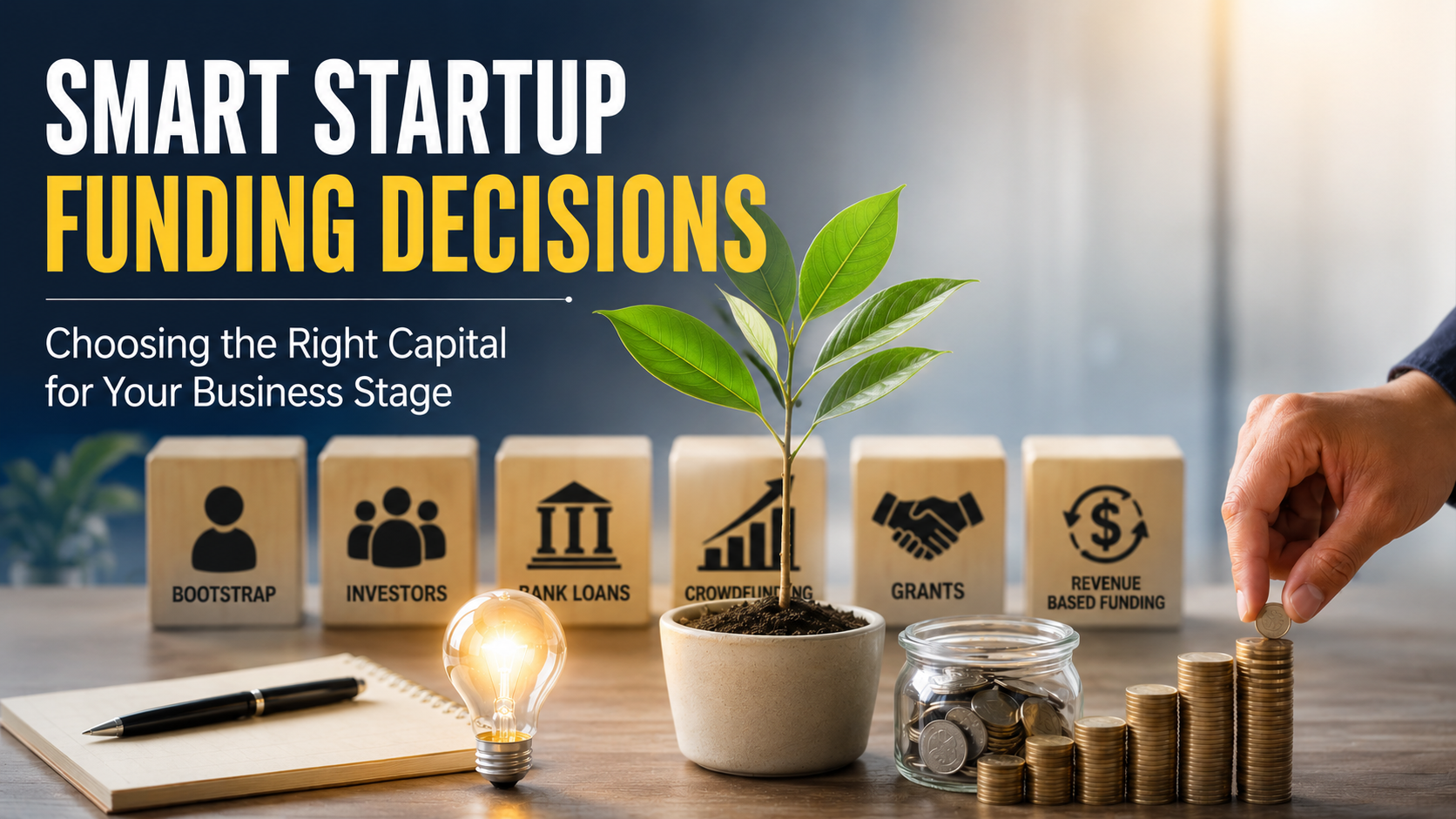
Every business needs capital, but not every business needs the same type of funding at the same time. One of the biggest mistakes founders make is chasing money before they fully understand what that money will cost them later.
The right funding decision depends on your stage of growth, your business model, your risk tolerance, and the level of control you want to keep. Some businesses grow steadily through customer revenue and careful spending. Others need outside investment to move quickly, build technology, hire teams, or capture market share before competitors do.
There is no single “best” funding path. The smartest founders choose capital that supports the business they are actually building, not the one investors expect them to become.
This guide breaks down the most common startup funding options, explains when each one makes sense, and highlights the trade-offs that can shape a company’s future for years.
Why Funding Strategy Matters More Than Most Founders Realise
Money does more than pay expenses. It changes how a business operates.
The moment outside capital enters a company, expectations change. Timelines become tighter. Growth targets increase. Decision-making may involve investors, lenders, or stakeholders who now have a financial interest in your direction.
Good funding accelerates progress.
Bad funding creates pressure before the business is ready.
That is why experienced entrepreneurs spend as much time evaluating funding structure as they do chasing the money itself.
A founder should always ask:
- How much capital is actually needed?
- What will this funding cost long term?
- Will this funding increase or reduce flexibility?
- Can the business realistically support repayment or investor expectations?
- Does this funding match the company’s current stage?
Businesses that answer these questions early tend to make stronger long-term decisions.
Bootstrapping: Building With Your Own Resources
Bootstrapping means funding the business yourself through personal savings, early customer revenue, or reinvested profits.
This is one of the most common startup funding methods because it allows founders to maintain full ownership and complete operational control.
Many successful businesses started this way, including Mailchimp and Basecamp. Both companies focused on sustainable growth rather than rapid outside-funded expansion.
When Bootstrapping Makes Sense
Bootstrapping often works well when:
- Startup costs are relatively low
- The business can generate revenue quickly
- Founders want full control
- Growth can happen gradually
- The company does not require expensive infrastructure or research
Service businesses, consulting agencies, content companies, and many online businesses often fit this model.
Advantages of Bootstrapping
- Full ownership remains with founders
- No investor pressure
- Greater freedom in decision-making
- Stronger financial discipline
- Easier long-term profitability focus
Challenges of Bootstrapping
- Slower growth
- Limited cash flow
- Higher personal financial risk
- Smaller hiring budgets
- Reduced ability to scale quickly
Bootstrapping works best when founders understand that patience becomes part of the strategy.
Angel Investors: Funding Early Growth
Angel investors are individuals who invest personal money into early-stage startups in exchange for equity ownership.
Unlike institutional investors, angel investors often support businesses during the idea or early growth stage when traditional banks may not lend.
Many startups use angel funding to validate products, hire early employees, or expand operations after initial traction.
When Angel Investment Makes Sense
Angel funding may fit businesses that:
- Have early traction or product validation
- Need growth capital before major revenue arrives
- Operate in scalable industries
- Require specialized mentorship or connections
- Need funding beyond what founders can self-finance
Technology startups frequently use this path, but it is increasingly common in healthcare, consumer products, and digital services.
Benefits of Angel Investors
- Access to industry expertise
- Faster funding decisions
- Networking opportunities
- Strategic guidance
- Flexible deal structures
Trade-Offs Founders Must Consider
- Ownership dilution
- Reduced decision autonomy
- Pressure for faster growth
- Potential misalignment with investors
Not all investor relationships are healthy. Some founders focus so heavily on securing funding that they ignore compatibility.
The right investor should support the business vision, not completely reshape it.
Bank Financing: Traditional but Still Valuable
Bank loans remain an important funding source for small businesses, especially those with predictable revenue and stable operations.
Unlike investors, banks do not take ownership. The trade-off is repayment responsibility regardless of business performance.
Businesses That Often Benefit From Bank Loans
Bank financing may work well for:
- Established small businesses
- Franchise operations
- Retail stores
- Manufacturing companies
- Businesses with physical assets
- Companies with consistent cash flow
Advantages of Bank Financing
- Founders keep ownership
- Predictable repayment schedules
- Lower long-term cost compared to equity
- Builds business credit history
Risks and Challenges
- Requires repayment regardless of profits
- May require collateral
- Approval standards can be strict
- Cash flow pressure during slow periods
A loan should support growth, not create financial strain that weakens operations.
Founders should avoid borrowing based on optimistic revenue projections alone.
Crowdfunding: Turning Customers Into Early Supporters
Crowdfunding allows businesses to raise money from large groups of people online.
Platforms like Kickstarter and Indiegogo helped popularize this model by allowing businesses to validate products before mass production.
Some campaigns offer products or rewards, while others provide equity opportunities.
When Crowdfunding Works Best
Crowdfunding tends to succeed when businesses have:
- Strong product stories
- Visually appealing products
- Clear customer demand
- Engaged online communities
- Consumer-focused offerings
Hardware products, creative projects, and lifestyle brands often perform well here.
Benefits of Crowdfunding
- Market validation before launch
- Early customer engagement
- Reduced reliance on investors
- Brand awareness growth
- Potential media attention
Common Crowdfunding Mistakes
Many campaigns fail because founders underestimate:
- Marketing costs
- Fulfilment complexity
- Shipping expenses
- Production delays
- Customer communication demands
Crowdfunding is not “easy money.” It requires careful planning, logistics, and audience building.
Grants: Non-Dilutive Funding Opportunities
Business grants provide capital that generally does not require repayment or ownership exchange.
Governments, universities, nonprofit organizations, and industry groups often provide grants for innovation, sustainability, research, education, or local economic development.
Grants Often Support
- Research-driven startups
- Green technology companies
- Healthcare innovation
- Rural businesses
- Minority-owned businesses
- Women-led businesses
Advantages of Grants
- No equity dilution
- No repayment obligations
- Increased business credibility
- Additional networking opportunities
Challenges of Grant Funding
- Highly competitive applications
- Long approval timelines
- Strict eligibility requirements
- Detailed reporting expectations
Grants can support growth, but businesses should not rely entirely on them for operational stability.
Revenue-Based Financing: Flexible Growth Capital
Revenue-based financing allows businesses to receive capital in exchange for a percentage of future revenue until repayment targets are met.
Unlike traditional loans, payments fluctuate based on income performance.
This funding model has become more popular among SaaS companies, subscription businesses, and ecommerce brands.
When Revenue-Based Funding Makes Sense
This option may work well when a business has:
- Consistent recurring revenue
- Predictable customer retention
- Strong margins
- Growth opportunities needing short-term capital
Advantages
- No major ownership dilution
- Flexible repayments
- Faster approval processes
- Scalable funding structures
Potential Downsides
- Can become expensive over time
- Revenue-sharing reduces cash flow
- Not ideal for unpredictable businesses
Founders should carefully compare total repayment costs against traditional financing.
How Funding Choices Affect Ownership and Control
Capital always comes with trade-offs.
The more outside funding a founder accepts, the more influence outside stakeholders may gain over business direction.
This does not automatically create problems. Many businesses thrive with investor partnerships.
But founders should understand how financing changes decision-making power.
Questions Every Founder Should Ask Before Accepting Funding
- How much ownership am I giving away?
- Will investors expect rapid expansion?
- What happens if growth slows?
- How much reporting will be required?
- Will I still control major decisions?
- Does this funding align with my long-term goals?
Some founders prioritize fast scaling.
Others value independence and sustainable growth.
Neither approach is universally correct.
Preparing Financial Projections That Investors Trust
Strong financial projections are essential regardless of funding type.
Investors, lenders, and grant providers all want evidence that founders understand their business economics.
Effective Financial Projections Usually Include
- Revenue forecasts
- Operating expenses
- Cash flow estimates
- Customer acquisition costs
- Pricing strategy
- Profit margin assumptions
- Growth milestones
Good projections are realistic, not exaggerated.
Experienced investors quickly recognize inflated forecasts that lack operational logic.
Clear assumptions matter more than unrealistic optimism.
How to Pitch Investors More Effectively
Many founders focus heavily on product features during investor pitches.
Most investors care more about business fundamentals.
A strong pitch usually explains:
- The problem being solved
- Market demand
- Revenue model
- Competitive advantage
- Customer traction
- Growth potential
- Financial strategy
- Team capability
Confidence matters, but clarity matters more.
Investors want founders who understand both opportunity and risk.
Common Startup Funding Mistakes to Avoid
Many funding problems begin long before money arrives.
Here are some of the most common mistakes founders make:
Raising Money Too Early
Outside funding before product-market fit can create pressure before the business model is proven.
Taking More Capital Than Necessary
Large funding rounds often increase growth expectations dramatically.
Ignoring Cash Flow Management
Businesses fail from poor cash flow more often than lack of ideas.
Choosing the Wrong Investors
Money alone does not make a strong partnership.
Overestimating Revenue
Aggressive projections damage credibility when results fall short.
Scaling Too Quickly
Rapid expansion without operational systems can create expensive instability.
The strongest businesses usually grow in stages rather than trying to scale everything at once.
Real-World Examples of Different Funding Paths
Different businesses succeed with very different funding strategies.
Spanx began largely through founder bootstrapping before expanding into a global brand.
Airbnb used investor funding to scale rapidly in a competitive global market.
GoPro combined early bootstrapping with later outside investment to expand production and distribution.
Patagonia prioritized sustainable long-term growth rather than aggressive outside-funded expansion.
Each company used funding strategies aligned with its business goals and operational needs.
Popular Questions
1. What is the safest funding option for a startup?
Bootstrapping is often the safest because founders keep ownership and avoid debt, though growth may happen more slowly due to limited available capital.
2. When should a startup seek investors?
A startup should usually seek investors after validating demand, showing traction, and developing a clear growth strategy supported by realistic financial projections.
3. Is crowdfunding a good option for small businesses?
Crowdfunding works well for consumer-focused products with strong storytelling, visual appeal, and engaged audiences willing to support early development.
4. What is revenue-based financing?
Revenue-based financing provides capital in exchange for a percentage of future business revenue until a repayment target is reached.
5. Why do startups fail after raising funding?
Many startups fail because they scale too quickly, manage cash flow poorly, over hire, or face investor pressure before building stable operations.
The Bottom Line
Choosing startup funding is not simply about getting access to cash. It is about deciding what kind of business you want to build and what trade-offs you are willing to accept along the way.
Some companies benefit from rapid investor-backed scaling. Others succeed through careful bootstrapping, disciplined growth, and operational independence. The smartest founders understand that funding should support the business model, not control it.
Strong financial planning, realistic projections, and thoughtful capital decisions create stability that lasts beyond early growth stages. Founders who understand both the opportunities and the risks behind each funding option are far more likely to build resilient businesses that can adapt over time.
The goal is not to raise the most money. The goal is to choose funding that gives the business the best chance to grow sustainably, profitably, and with the right level of control.