
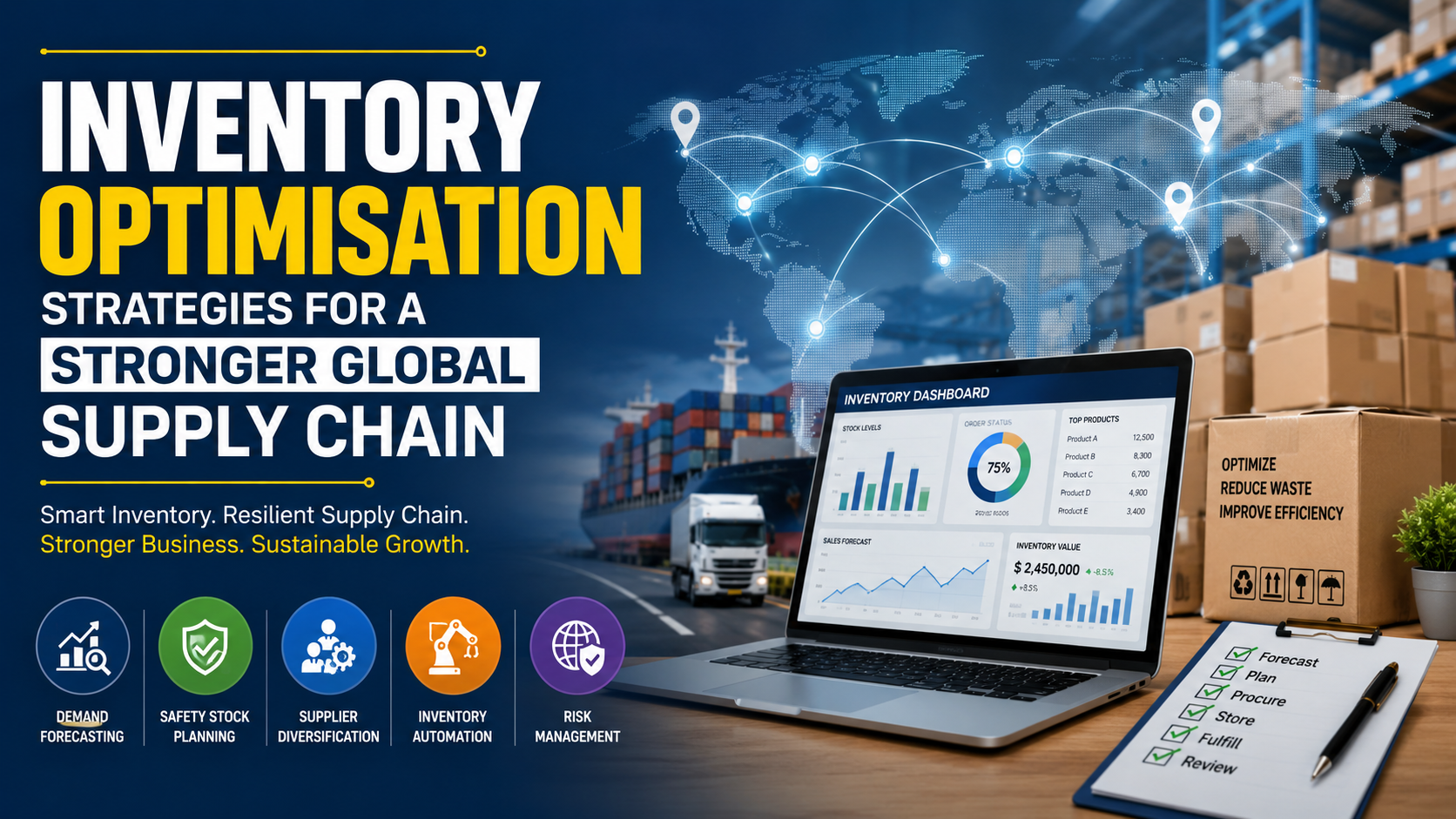
Modern supply chains face constant pressure. Businesses must manage rising customer expectations, fluctuating demand, shipping delays, and increasing operational costs while keeping inventory moving efficiently. Too much stock ties up cash and storage space. Too little inventory leads to shortages, delayed deliveries, and frustrated customers.
That is why inventory optimization has become one of the most important long-term strategies in global supply chain management. Companies that build smarter inventory systems are often better prepared for disruptions, market changes, and growth opportunities. They can respond faster, reduce waste, improve customer satisfaction, and protect profitability simultaneously.
Inventory optimization is not simply about storing products. It is about creating balance across forecasting, purchasing, warehousing, supplier management, transportation, and customer demand. When these areas work together, businesses gain stronger control over their operations and build a more resilient supply chain.
Why Inventory Optimization Matters More Than Ever
Global supply chains are more connected than ever before. A delay in one region can affect manufacturing, shipping, retail availability, and customer delivery timelines across multiple countries.
Businesses now face challenges such as:
- Rising transportation costs
- Supply chain disruptions
- Unpredictable consumer demand
- Raw material shortages
- Longer supplier lead times
- Economic uncertainty
- Seasonal inventory fluctuations
Poor inventory management can quickly create operational problems. Excess stock increases storage and insurance costs. Low inventory levels can result in missed sales opportunities and damaged customer trust.
Effective inventory optimization helps businesses:
- Improve inventory visibility
- Reduce unnecessary stock holding
- Minimize waste and obsolete products
- Maintain healthy cash flow
- Improve fulfillment speed
- Strengthen supply chain resilience
Companies that treat inventory as a strategic asset often perform better during both stable and uncertain market conditions.
Building Accurate Demand Forecasting Systems
Demand forecasting is the foundation of successful inventory planning. Businesses cannot optimize inventory if they do not understand purchasing patterns and customer behavior.
Strong forecasting combines historical sales data, market trends, seasonal changes, and customer insights to predict future demand more accurately.
Modern forecasting strategies often include:
Historical Data Analysis
Past sales patterns help businesses identify recurring trends, seasonal demand spikes, and slow-moving inventory categories.
Real-Time Market Monitoring
Businesses now monitor shifts in customer demand, industry trends, and competitor activity in real time to adjust inventory planning quickly.
Predictive Analytics
Advanced analytics tools use machine learning and operational data to improve forecasting accuracy over time.
Cross-Department Collaboration
Sales, marketing, procurement, and warehouse teams should work together when forecasting inventory needs. This improves planning accuracy and reduces communication gaps.
Better forecasting reduces the risk of both overstocking and understocking while improving supply chain efficiency.
The Importance of Safety Stock Planning
Even the best forecasting models cannot predict every disruption. Weather events, supplier delays, port congestion, and sudden demand spikes can interrupt inventory flow without warning.
Safety stock acts as a protective buffer that helps businesses continue operations during unexpected situations.
However, carrying too much safety stock can increase storage costs and reduce cash flow. The goal is to find the right balance.
Businesses typically calculate safety stock based on:
- Supplier lead times
- Demand variability
- Sales velocity
- Product importance
- Service level goals
- Historical disruption patterns
Critical products often require higher safety stock levels than slower-moving or low-priority items.
Businesses that review safety stock regularly can adjust inventory levels based on changing market conditions rather than relying on outdated assumptions.
Diversifying Suppliers to Reduce Risk
Supplier diversification has become a major inventory strategy in global supply chain management. Relying heavily on a single supplier or region creates significant operational risk.
Many companies experienced this during global shipping disruptions, factory shutdowns, and geopolitical instability in recent years.
Diversifying suppliers helps businesses:
- Reduce dependency on one source
- Improve supply chain flexibility
- Shorten recovery time during disruptions
- Increase negotiating power
- Improve sourcing reliability
A strong supplier diversification strategy may include:
Regional Supplier Networks
Using suppliers from different regions helps reduce exposure to local disruptions.
Secondary Backup Suppliers
Backup vendors provide additional security if primary suppliers face delays or shortages.
Supplier Performance Monitoring
Businesses should regularly evaluate supplier reliability, quality, delivery performance, and communication.
Long-Term Supplier Relationships
Reliable supplier partnerships often improve collaboration, forecasting accuracy, and inventory planning.
Supplier diversification strengthens inventory stability while reducing long-term operational risk.
Using Inventory Automation for Better Control
Manual inventory management can slow operations and increase errors. As supply chains grow more complex, automation becomes essential for maintaining accuracy and visibility.
Inventory automation tools help businesses monitor stock levels, movement, replenishment, and warehouse activity in real time.
Common inventory automation technologies include:
| Technology | Primary Benefit |
| Barcode Systems | Faster inventory tracking |
| RFID Tracking | Real-time stock visibility |
| Warehouse Management Systems | Improved storage efficiency |
| Inventory Management Software | Automated replenishment |
| AI Forecasting Tools | Better demand predictions |
| Cloud-Based Platforms | Centralized inventory data |
Automation helps businesses reduce:
- Human error
- Inventory discrepancies
- Delayed replenishment
- Manual reporting delays
- Stock visibility problems
It also improves operational speed and decision-making across the supply chain.
Reducing Inventory Waste and Storage Costs
Inventory waste affects profitability more than many businesses realize. Excess inventory increases warehousing costs, insurance expenses, product depreciation, and spoilage risks.
Optimized inventory systems focus on keeping stock levels aligned with actual demand.
Strategies that reduce inventory waste include:
ABC Inventory Analysis
Businesses classify products based on value, sales frequency, and profitability. High-value items receive closer monitoring and tighter inventory control.
Just-In-Time Inventory Practices
Some businesses reduce storage costs by ordering inventory closer to production or sales timelines.
Slow-Moving Inventory Reviews
Regular audits help identify products that are underperforming or becoming obsolete.
Warehouse Space Optimization
Efficient warehouse layouts improve storage capacity, picking speed, and inventory accessibility.
Reducing waste not only improves profitability but also supports sustainability goals by lowering excess production and disposal.
Managing Inventory During Supply Chain Disruptions
Supply chain disruptions are now considered a normal business risk rather than a rare event. Companies must build inventory strategies that allow flexibility during uncertainty.
Strong disruption management plans often include:
- Emergency inventory reserves
- Multiple shipping routes
- Alternative suppliers
- Flexible warehousing solutions
- Real-time inventory monitoring
- Faster decision-making systems
Businesses that react slowly to disruptions often experience larger financial losses and customer dissatisfaction.
Agile inventory management allows companies to shift purchasing, sourcing, and fulfillment strategies quickly when conditions change.
The Role of Data Visibility in Inventory Optimization
Inventory visibility is one of the most valuable advantages in modern supply chain operations.
When businesses can track inventory movement across warehouses, suppliers, distribution centers, and retail channels, they can make faster and more informed decisions.
Improved visibility helps businesses:
- Prevent stock shortages
- Identify bottlenecks quickly
- Improve order accuracy
- Reduce excess inventory
- Improve customer service
- Strengthen forecasting accuracy
Cloud-based inventory platforms and integrated supply chain systems now provide businesses with real-time operational insights that were previously difficult to obtain.
Better visibility creates stronger coordination across the entire supply chain network.
Balancing Inventory Costs With Customer Expectations
Customers expect faster delivery, consistent product availability, and reliable fulfillment. At the same time, businesses must control inventory costs to remain competitive.
Inventory optimization requires balancing both goals carefully.
Businesses can improve this balance by:
- Positioning inventory closer to demand centers
- Using regional fulfillment hubs
- Improving order forecasting
- Optimizing replenishment cycles
- Automating fulfillment operations
- Improving communication with suppliers
Companies that align inventory strategy with customer expectations often improve both profitability and customer loyalty.
Long-Term Inventory Strategies for Sustainable Growth
Inventory optimization is not a one-time project. It requires continuous improvement, regular analysis, and ongoing adaptation.
Businesses that build long-term inventory strategies typically focus on:
- Operational flexibility
- Real-time data access
- Scalable inventory systems
- Supply chain resilience
- Supplier collaboration
- Continuous forecasting improvements
As global markets continue to evolve, inventory optimization will remain a critical part of operational success.
Businesses that invest in smarter inventory management today are often better prepared for future disruptions, growth opportunities, and changing customer behavior.
Questions & Answers
What is inventory optimization in supply chain management?
Inventory optimization is the process of maintaining the right stock levels to meet demand while reducing storage costs, shortages, and operational waste across the supply chain.
Why is demand forecasting important for inventory management?
Demand forecasting helps businesses predict customer demand accurately, reducing the risk of overstocking, stock shortages, and unnecessary operational costs.
How does inventory automation improve supply chain performance?
Inventory automation improves stock accuracy, real-time tracking, replenishment speed, and operational efficiency while reducing manual errors and reporting delays.
What is safety stock in inventory management?
Safety stock is extra inventory kept as a buffer to protect businesses from supplier delays, unexpected demand increases, or supply chain disruptions.
How can supplier diversification reduce supply chain risk?
Supplier diversification reduces dependency on a single supplier or region, helping businesses maintain inventory flow during disruptions or market instability.
Summing Up
Inventory optimization plays a central role in building a stronger and more reliable global supply chain. Businesses that improve forecasting, diversify suppliers, automate inventory systems, and strengthen visibility can reduce waste while improving operational performance.
The most successful companies treat inventory management as a strategic advantage rather than a basic operational task. They continuously evaluate stock levels, adapt to market conditions, and improve decision-making across their supply chain networks.
In a world where disruptions, demand shifts, and global competition continue to shape business operations, efficient inventory management provides stability, flexibility, and long-term growth potential. Companies that build resilient inventory strategies today will be better positioned to manage uncertainty and maintain strong supply chain performance in the years ahead.